Muhammad Amanullah
Date: October 26, 2026
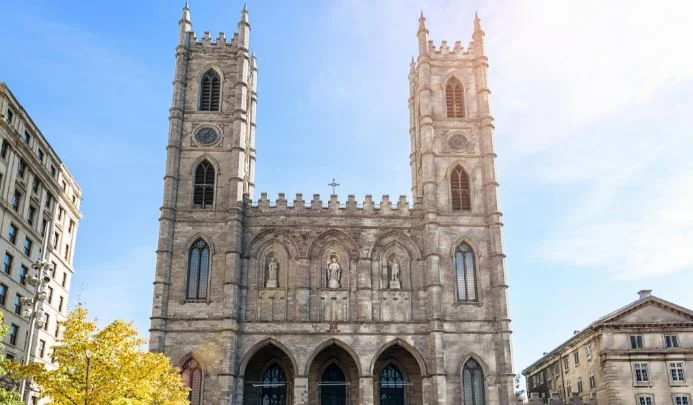
The True Post (Web News) —Montreal’s historic Notre-Dame Basilica has unveiled its restored exterior to the public, marking a major milestone in an extensive preservation project involving one of the city’s most significant architectural and cultural landmarks.
The restored exterior was officially presented on Sunday after years of work behind scaffolding and construction structures that reached approximately 10 storeys high. Specialists have been repairing and reinforcing the historic stonework while preserving the architectural features that give the nearly 200-year-old building its distinctive character.
More than 800 guests were expected to attend the unveiling celebrations, which included special musical performances in the basilica’s outdoor courtyard and inside the church.
The event highlighted the progress made in restoring the landmark and renewed attention on the importance of preserving Montreal’s architectural heritage for future generations.
$100 Million Restoration Project Expected to Continue for Years
The restoration of Notre-Dame Basilica, covering both the exterior and interior of the building, is estimated to cost approximately $100 million Canadian dollars.
Work began nearly a decade ago, and the complete restoration is expected to take several more years.
The project was launched after concerns emerged about the structural condition of parts of the historic building. Initially, experts feared that the left hand of a statue of the Virgin Mary might fall. However, closer inspections revealed that the problem extended beyond the statue, with several sections of the building’s exterior also facing potential deterioration or collapse.
Following these findings, specialists began detailed inspections of the stonework, joints and other architectural components to identify weaknesses and determine the repairs needed to protect the structure.
The restoration has involved careful examination and reinforcement of the exterior, with particular attention paid to preserving the building’s historical appearance.
More Than 150 Musicians Perform at the Unveiling
Music formed a central part of the celebrations marking the presentation of the restored exterior.
The programme featured more than 150 musicians from the Société philharmonique du Nouveau Monde, who performed Misa Tango, a composition by Martín Palmeri, under the artistic direction of Michael Brousseau.
Organist Jean-Willy Kunz also delivered a special musical performance.
Some performances took place in the basilica’s outdoor courtyard, while others were held inside the church, allowing guests to experience the music within the historic setting.
The event combined artistic performances with the restoration milestone, drawing attention to the basilica’s continuing role in Montreal’s cultural and religious life.
Interior Restoration Could Take Another Five to 10 Years
Although the exterior restoration has reached a significant milestone, work inside the basilica remains ongoing.
Michel Issa, general manager of the Fabrique de la paroisse Notre-Dame de Montréal, which administers the parish, has previously estimated that restoring the interior could require another five to 10 years.
The overall project has a target completion date of 2035.
Interior restoration work includes preserving historic walls, decorative details and painted murals. Specialists are seeking to protect the original materials and artistic features rather than simply repainting or replacing them.
The objective is to retain as much of the building’s original character as possible while ensuring that its interior features remain stable and protected.
Issa has emphasised the importance of inspecting and assessing every stone used in the building. If a stone cannot be repaired, a replacement must be carved to match its original shape and structure.
This process requires considerable time and specialised expertise because even small alterations can affect the building’s historic appearance.
Shortage of Historic Stone Creates Restoration Challenges
The availability of suitable stone is one of the major challenges facing the restoration project.
Dino Bombardier, director of policy at Heritage Montreal, said the lengthy restoration process was understandable given the age and importance of the structure. He described Notre-Dame Basilica as one of the buildings that form a particularly significant part of Montreal’s architectural heritage.
According to Bombardier, when the basilica opened in 1830, it was considered one of the largest buildings on the American continent. Its seating capacity exceeded 5,000 people, which was regarded at the time as sufficient to accommodate the city’s entire population.
The basilica’s historic construction relied on distinctive materials, including Montreal grey stone. However, finding suitable replacements has become increasingly difficult because some of the quarries that once supplied the material have closed.
Bombardier noted that discussions about natural heritage often focus on forests, landscapes and other environmental features, while the stone used in a city’s historic architecture can also form an important part of its natural and cultural identity.
The difficulty of sourcing stone that closely matches the original material has therefore become a significant consideration in the restoration.
Using appropriate replacement materials is essential not only for structural stability but also for maintaining the building’s distinctive appearance and historical authenticity.
Traditional Restoration Skills Are Becoming Increasingly Rare
The shortage of suitably skilled craftspeople presents another challenge for the project.
Restoring historic stone buildings requires specialists who understand traditional methods of stone cutting, repair and conservation. According to Issa, relatively few professionals possess the expertise needed for this type of work.
The limited availability of experienced craftspeople can complicate the restoration process and contribute to the time required to complete individual stages.
Bombardier compared the current situation with the construction of the basilica nearly two centuries ago, when hundreds of workers were involved in the project.
He said the building’s construction was also influenced by a desire to establish a grand Catholic church at a time when Protestant churches were expanding across the region.
Over time, however, traditional building and restoration techniques have received insufficient attention, contributing to a decline in the number of professionals capable of carrying out such specialised work.
The preservation of these skills has consequently become an important issue alongside the conservation of the building itself.
Without enough trained craftspeople, projects involving historic structures can face additional delays and difficulties in maintaining traditional standards of workmanship.
Fundraising Supports the Basilica’s Long-Term Preservation
Funding for the restoration is being raised through donations, fundraising campaigns and other initiatives.
One of these initiatives is Le Firmament café, located within the basilica complex and operated in partnership with Café Saint-Henri.
Such efforts form part of the broader work required to maintain the building and finance its long-term preservation.
The project extends beyond improving the basilica’s appearance. It also seeks to protect its historic stonework, interior decoration and structural elements so that future generations can continue to experience the landmark.
The restored exterior represents a significant achievement after years of construction and conservation work. However, substantial tasks remain, particularly inside the building, where historic surfaces and decorative features require careful treatment.
The continuing challenges include securing suitable replacement stone, finding skilled restoration workers and maintaining the financial resources needed to complete the work.
Preserving Notre-Dame Basilica will therefore require sustained funding, specialised craftsmanship and long-term planning.
A Landmark in Montreal’s Architectural Heritage
Notre-Dame Basilica remains an important part of Montreal’s architectural, cultural and religious history.
The unveiling of its restored exterior demonstrates the progress made in protecting the structure while retaining the features that connect it to the city’s past.
The restoration also highlights the complexity of conserving historic buildings. Such projects demand more than conventional construction work: they require detailed inspections, historically appropriate materials and specialised techniques capable of protecting original architectural elements.
With the interior restoration expected to continue for years and the overall project targeting completion in 2035, the latest unveiling marks an important stage rather than the end of the work.
For Montreal, the effort represents a long-term investment in preserving a landmark whose architectural and cultural significance extends well beyond its physical structure.