Muhammad Amanullah | The True Post
Canada and the European Union have removed the controversial term “associate membership” from the draft of a joint declaration ahead of a two-day summit in Montreal, opting instead to pursue an “ever closer association” between Canada and the 27-member bloc.
The change follows opposition from several EU member states, particularly Germany, which raised concerns about the legal meaning and practical implications of creating an associate membership status that does not currently exist within the EU’s formal framework.
According to reports by CBC News and Reuters, the revised draft commits both sides to strengthening their relationship through closer cooperation on trade, security, energy, critical minerals and other strategic priorities. The document is expected to be made public following the summit, although the final wording remains subject to the applicable approval process.
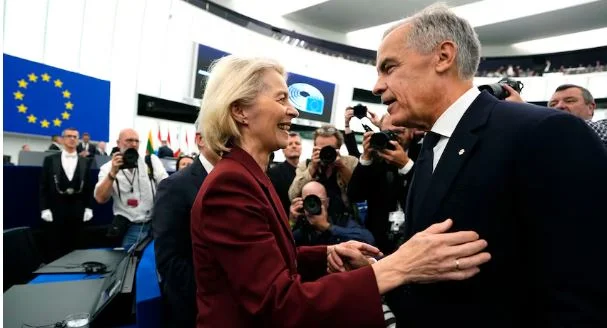
European Commission President Ursula von der Leyen, who proposed making Canada the EU’s first associate member last month, continued to use the term after arriving in Montreal, highlighting a difference between her stated ambition and the more cautious language adopted in the draft declaration.
Why Was ‘Associate Membership’ Removed?
Von der Leyen surprised many observers in September when she announced that the European Union would begin the process of making Canada its first associate member.
The proposal was intended to signal a substantial expansion of relations between Canada and Europe. However, the EU has no established legal category formally known as “associate membership”, raising questions about what such a status would mean and how it could operate in practice.
Some European governments expressed concern that endorsing the term before defining its legal and political implications could create uncertainty and set a precedent for relations with other non-member countries.
Germany emerged as a particularly vocal opponent. According to sources cited in media reports, Berlin regarded the terminology as unacceptable and treated it as a red line during negotiations over the joint declaration. France, Italy and Greece were also reported to have raised objections to aspects of earlier drafts.
The revised wording replaces the associate membership proposal with a commitment to an “ever closer association” between Canada and the European Union.
The draft also envisages further work to define the scope of the relationship by the next Canada-EU summit in 2027. This suggests that both sides intend to continue negotiations on the substance of their partnership, even though the disputed label has been removed.
Mark Carney: The Benefits Matter More Than the Name
Canadian Prime Minister Mark Carney has emphasised that the practical results of closer relations with Europe matter more than the terminology used to describe the arrangement.
Speaking to reporters ahead of a cabinet meeting on Tuesday, Carney said the relationship should be judged by the difference it makes to Canadians rather than by a particular title.
“The good news is it doesn’t matter about specific names or nomenclature,” he said, according to reports of his remarks.
Carney added that what matters is how the partnership improves Canadians’ lives and helps Canada become a more independent and sovereign country.
His comments reflect the Canadian government’s focus on the economic and strategic benefits of closer European cooperation, rather than on whether the relationship is formally described as associate membership or an alliance.
The Montreal summit is expected to launch a further period of formal negotiations over the future framework.
Ursula von der Leyen Continues to Advocate Associate Membership
Despite the removal of the term from the draft declaration, von der Leyen reiterated her ambition to bring Canada closer to the European Union.
After arriving in Montreal on Wednesday, the European Commission president posted a message on social media describing the close relationship between Europe and Canada and expressing a desire to make Canada the bloc’s first associate member.
She wrote that although an ocean separates Europe and Canada, the two sides have never felt closer. She also described the summit as an opportunity to begin a new chapter in their shared history.
Her remarks underline the European Commission’s interest in expanding cooperation with Canada, even as EU member states continue to debate the language and legal framework through which that relationship should develop.
The distinction is significant: the proposed partnership could become much closer without making Canada a full EU member or establishing a formally recognised associate membership category.
Canada Seeks to Reduce Economic Dependence on the United States
The summit comes as Canada looks to diversify its trade and strategic relationships amid continuing tensions with the United States under President Donald Trump.
Washington’s tariff policies and uncertainty surrounding bilateral trade have encouraged Ottawa to strengthen ties with other major economic partners.
The United States remains Canada’s dominant export market, while the European Union represents a smaller share of Canadian trade. Expanding commercial opportunities in Europe could help Canada reduce some of its dependence on the US market, although building alternative trade relationships on a comparable scale would take time.
Closer cooperation with Europe is also intended to strengthen Canada’s position in areas such as energy security, defence, technology and access to critical minerals.
According to reporting by Reuters and other outlets, the draft declaration includes several proposed initiatives intended to turn the political commitment into practical cooperation.
These include improving connectivity between Europe, Canada and Asia through new subsea cable infrastructure, examining the feasibility of Canadian liquefied natural gas exports to Europe and creating opportunities for young Canadians and Europeans to work across the Atlantic.
The proposed agenda also covers a more predictable trading environment, cooperation in the Arctic, efforts to counter foreign information manipulation and interference, and continued support for Ukraine.
Other priorities include strengthening energy security, improving critical-mineral supply chains and advancing cooperation on the security and safe use of artificial intelligence.
The proposals would expand the relationship beyond conventional trade and diplomatic engagement into areas that increasingly shape economic resilience and national security.
Digital Rules and Economic Security Could Become Sensitive Issues
Closer alignment between Canadian and European policies could also create challenges, particularly in areas where the two sides seek to establish common approaches to technology and economic security.
The draft declaration reportedly includes a commitment to cooperation on artificial intelligence and digital regulation. Such coordination could improve compatibility between Canadian and European rules, but it may also become a point of tension with Washington, which has criticised aspects of the European Union’s regulatory approach.
The broader partnership also seeks to reinforce international law and a rules-based international order.
However, closer Canadian-European coordination does not necessarily mean that every initiative will be implemented immediately. Specific proposals will require further negotiations, and some may depend on domestic approval processes, technical assessments or agreements between the participating governments.
The summit is therefore expected to establish a framework for future work rather than resolve every question about the relationship at once.
Mark Carney to Meet Business Leaders
Alongside the formal summit discussions, Carney is scheduled to host a roundtable with business leaders on Thursday.
He is also expected to host a dinner in honour of von der Leyen and European Council President António Costa.
The meetings will provide an opportunity to discuss the commercial implications of closer Canada-EU relations, including investment, energy, critical minerals, trade and security.
Business leaders on both sides will be watching for concrete measures that could make it easier to expand investment, improve market access and establish more reliable supply chains.
The discussions may also help identify areas where private-sector investment can support the governments’ broader strategic objectives.
What Happens Next?
The removal of “associate membership” from the draft declaration represents a compromise over terminology, rather than an abandonment of the broader effort to strengthen relations.
Canada and the European Union are still seeking a closer partnership, but the exact scope, legal basis and practical benefits of that relationship will require further work.
The draft envisages continued negotiations leading towards the next summit in 2027, when both sides aim to have a clearer understanding of what an “ever closer association” would involve.
For Canada, the priority is to secure tangible economic and strategic benefits while expanding its international options. For the European Union, the challenge is to deepen cooperation with an important partner without introducing a new status that member states have not agreed upon.
The outcome of the Montreal summit could therefore mark an important step in Canada’s efforts to strengthen its ties with Europe, even as questions remain about how far the partnership will ultimately go.