Muhammad Amanullah
Date: September 30, 2026 The True Post (Web News) —The provincial election campaign in British Columbia has intensified, with political parties holding public gatherings and campaign events in different parts of the province on the seventh day of campaigning. The BC Conservatives and BC NDP have made energy, liquefied natural gas (LNG), minerals and exports key campaign issues, while the BC Greens have proposed a universal child-care plan aimed at reducing the cost of living and child-care expenses.
Energy Takes Centre Stage in Election Campaign
Against the backdrop of the federal government’s goal of making Canada a global energy superpower, political parties in British Columbia have also placed the province’s energy resources and export potential at the centre of their campaigns.
BC Conservative interim leader Lorne Doerkson unveiled his party’s new “BC Energy Superpower Plan,” saying it would create opportunities for new investment in the province’s LNG sector.
Plan to Triple LNG Production
Under the Conservative Party’s proposal, British Columbia would aim to triple its LNG production by 2035.
Doerkson said British Columbia has some of the world’s richest, clean and abundant natural gas reserves. However, he argued that having resources alone is not enough and that the province also needs the necessary infrastructure to deliver its products to international markets.
He said that if the plan were implemented effectively, it could bring significant changes for residents of British Columbia.
Pledge to Avoid New Taxes
Doerkson claimed that the economic activity generated by his party’s energy plan could help the government meet its financial priorities without imposing additional taxes.
He criticised the NDP government, arguing that the province had not taken sufficient steps to expand its export capacity. As a result, he said, British Columbia remained dependent on a limited number of buyers for its energy products.
According to Doerkson, this situation makes the province’s resource trade more vulnerable to external pressure.
NDP Responds to Conservative Energy Plan
The BC NDP responded to the Conservative Party’s energy proposal by saying that efforts to increase LNG production were already underway.
According to the NDP, current projections indicate that British Columbia is on track to increase LNG production by more than three times by 2035. The party said a similar pace of development was now needed in the province’s mining sector.
Expansion of the Port of Prince Rupert
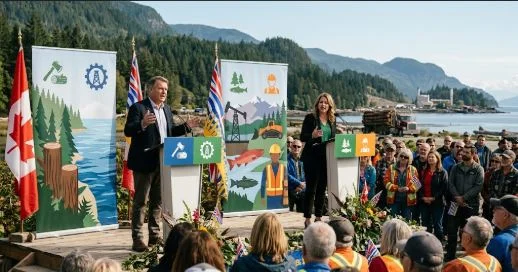
BC NDP Leader David Eby emphasised the importance of diversifying the province’s trading partners during a campaign event in Prince Rupert.
He announced plans to expand the Port of Prince Rupert, saying the objective was to make it Canada’s second-largest port after Vancouver by 2030.
Eby said British Columbia needed to strengthen its position in global trade by expanding exports and gaining access to new markets for its natural resources.
Increasing Production of Critical Minerals
Eby also announced plans to increase the production of critical metals and minerals in British Columbia. According to him, the province aims to double the production of critical metals and minerals exported from British Columbia over the next five years.
He said investment in energy, minerals and port infrastructure could strengthen the province’s economic foundation.
Eby also argued that British Columbia should develop its economy in a way that protects residents’ jobs and economic interests, even in the face of external pressure.
Greens Propose Child-Care Plan
Meanwhile, BC Green Party Leader Emily Lowan made universal child care one of her priorities during the election campaign on Vancouver Island, focusing on reducing inflationary pressures and household expenses.
She proposed immediately strengthening the $10-a-day child-care programme and making child care completely free within five years.
Women and Employment
According to Lowan, affordable or free child care would help parents, particularly those unable to work because of childcare responsibilities, return to employment.
The Green Party argues that some of the public investment in child care could be recovered through tax revenue when parents return to work.
The Greens have also pledged better wages and pension benefits for workers employed in the child-care sector.
Meanwhile, CentreBC and OneBC did not hold any campaign events on Monday.
On the seventh day of the election campaign, energy, LNG, minerals, port infrastructure, trade and child care remained prominent issues in the political parties’ platforms and campaign activities across British Columbia.