The True Post (Web News)
Muhammad Aman Ullah
August 31, 2026
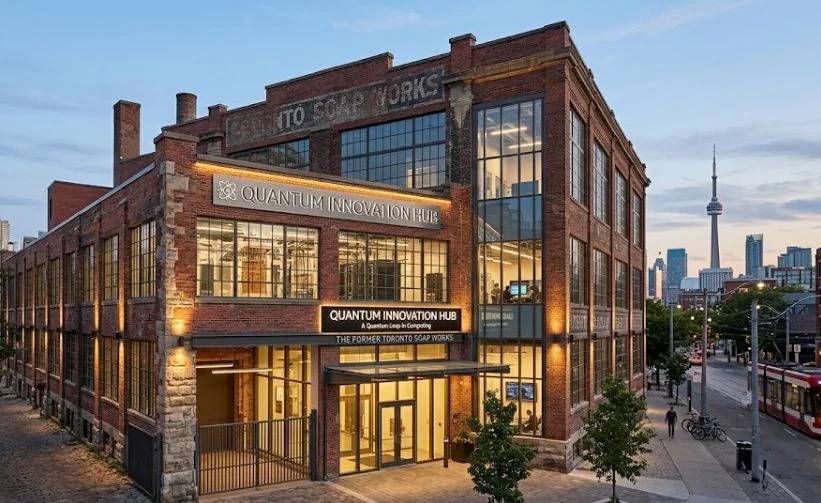
A former soup manufacturing plant in Toronto is set to become a major hub for quantum computing technology as Canadian technology company Xanadu Quantum Technologies plans to transform the old Campbell Soup facility into a state-of-the-art manufacturing centre.
The Canadian federal government has announced $195 million in repayable financial support for the project, which is expected to strengthen Canada’s domestic technology and advanced manufacturing capabilities.
From Soup Production to Quantum Technology
The former Campbell Soup plant in Toronto’s west end has remained largely inactive for years. The building will now be redeveloped into a manufacturing facility focused on producing advanced photonic quantum computers.
The planned facility will cover approximately 158,000 square feet, with the overall project expected to cost around $893 million.
The project is also expected to create approximately 275 jobs, turning a former food-production site into a centre focused on one of the world’s most advanced areas of computing.
Xanadu’s Photonic Approach to Quantum Computing
Xanadu Quantum Technologies, founded in 2016, develops quantum computers and software based on photonic technology.
Unlike conventional computers that primarily process information using electrical signals, photonic quantum systems use particles of light, known as photons, to process and transmit information.
One potential advantage of this approach is that photonic systems can reduce some of the cooling requirements associated with other types of quantum computers.
Xanadu is working toward developing quantum computing systems that can eventually operate at large scale and address some of the technical challenges currently facing the industry.
Building More Reliable Quantum Computers
One of the biggest challenges in quantum computing is developing systems that can operate reliably while controlling errors that occur during quantum calculations.
Xanadu announced a new chip in June designed to produce more resilient photonic qubits.
A qubit is the basic unit of information used in quantum computing. Unlike conventional computer bits, qubits operate according to the principles of quantum mechanics, potentially allowing quantum computers to tackle certain highly complex problems in fundamentally different ways.
Canada Joins the Global Quantum Race
Canada is competing with major technology powers, including the United States, China and European countries, to establish a strong position in quantum technology.
Advances in quantum computing could eventually have applications in areas such as artificial intelligence, cybersecurity, medical research, advanced materials and other high-tech industries.
Canadian Minister of Artificial Intelligence and Digital Innovation Evan Solomon has described quantum technology as strategically important for Canada’s economic competitiveness, technological capabilities and national security.
Federal Government’s Quantum Strategy
The Canadian federal government launched its National Quantum Strategy in 2023 with $360 million in funding.
The $195 million announced for Xanadu represents one of the largest single federal financial commitments toward quantum technology manufacturing under the strategy.
The funding will be provided through the federal government’s Strategic Response Fund.
Xanadu had previously received $40 million in federal support in 2023.
Ontario Could Provide Another $195 Million
Xanadu announced in March that it was negotiating with the federal and Ontario governments for up to $390 million in combined support to expand semiconductor and photonic manufacturing capabilities in Canada.
Following the federal government’s $195 million commitment, Xanadu CEO Christian Weedbrook said discussions with the Ontario government over another potential $195 million remain ongoing.
If the provincial funding is approved, total government support for the project could increase significantly.
Potential Applications in AI and Medicine
Quantum computing is expected to play an increasingly important role in several emerging technologies.
Researchers and technology companies are exploring its potential applications in artificial intelligence, drug and medical research, cybersecurity, materials science and complex computational problems.
Although large-scale quantum computing is still developing, governments and technology companies around the world are investing heavily in the sector in anticipation of its future capabilities.
Toronto’s Industrial Past Meets Future Technology
The transformation of the former Campbell Soup facility represents an unusual transition from traditional manufacturing to advanced technology.
A building once used to produce food could soon be producing components and systems designed for the next generation of computing.
With an expected project cost of approximately $893 million, federal support of $195 million and potential additional funding from Ontario, the facility could become an important part of Canada’s growing quantum technology ecosystem.
If the project proceeds as planned, the former Toronto soup factory could create hundreds of jobs while helping Canada strengthen its position in the global quantum computing industry.