Muhammad Amanullah
Date: October 15, 2026
The True Post (Web News) —
A new survey conducted in Alberta’s two largest cities suggests that the province’s separatist movement faces a significant challenge, with 85 per cent of respondents in Calgary and Edmonton supporting Alberta remaining part of Canada.
According to the survey, conducted by Canada Pulse Insights exclusively for CityNews, only 15 per cent of respondents in both cities supported beginning the constitutional process that could lead to a legally binding referendum on Alberta’s separation from Canada.
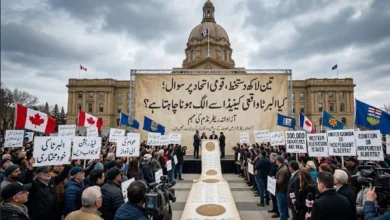
The findings were released on Wednesday, ahead of an October 19 referendum that will ask Albertans to vote on several questions concerning the province’s future, its relationship with the federal government and the division of powers between Ottawa and the provincial government.
Referendum Question Focuses on Constitutional Process
Question 10 on the referendum ballot asks voters whether Alberta should remain a province of Canada or whether the provincial government should begin the constitutional process required to hold a definitive and legally binding referendum on separation.
The survey found that 85 per cent of respondents in both Calgary and Edmonton favoured keeping Alberta within Canada, while 15 per cent supported starting the constitutional process related to separation.
When respondents were asked more directly whether Alberta should become an independent and sovereign country, support for independence remained a minority position in both cities.
In Calgary, 16 per cent said they supported Alberta becoming an independent country, while 84 per cent preferred that the province remain part of Canada.
In Edmonton, support for independence was lower. Only 13 per cent favoured Alberta becoming a sovereign country, compared with 87 per cent who wanted the province to remain within Canada.
Views Among Likely Referendum Voters
The survey also examined the opinions of people who said they were certain to cast a ballot in the referendum.
Among these likely voters in Calgary, 85 per cent supported keeping Alberta as a Canadian province, while 15 per cent favoured beginning the constitutional process toward separation.
In Edmonton, 83 per cent of respondents who were certain to vote supported remaining part of Canada, while 17 per cent backed initiating the constitutional process for separation.
When asked directly about independence, 15 per cent of likely voters across the two cities supported Alberta becoming an independent country.
John Wright of Canada Pulse Insights said the results suggested that approximately one in six people in the two cities supported separation. He also explained that the survey asked respondents whether they intended to go to a polling station to vote on the issue.
Political Affiliation Plays a Role
Wright said the debate should not be viewed simply as a divide between urban and rural Alberta. Political affiliation also plays an important role in shaping public opinion.
According to Wright, people associated with Alberta’s United Conservative Party are more likely to support separation than other groups.
Supporters of independence argue that leaving Canada would give Alberta greater control over its affairs, including freedom from federal taxation and regulations. They believe the province could make more decisions independently if it were no longer part of the Canadian federation.
Opponents, however, warn that separation could create economic uncertainty, harm businesses and increase costs. They also argue that an independent Alberta would have to assume responsibility for services currently provided or supported by the federal government.
The competing arguments have made Alberta’s future relationship with Canada a significant political issue ahead of the referendum.
Ten Questions on the Referendum Ballot
The referendum called by Alberta Premier Danielle Smith includes 10 questions covering a range of constitutional, immigration and public-service issues.
In addition to the question concerning separation from Canada, voters will be asked about proposals to expand provincial authority over immigration, introduce eligibility requirements for publicly funded services, impose residency requirements for social assistance and charge certain temporary residents fees for health and education services.
One proposal concerns requiring proof of Canadian citizenship to vote.
Other questions address constitutional changes, including working with other provinces to pursue reforms, abolishing the Senate, expanding provincial influence over appointments to superior courts and retaining funding despite opting out of certain federal programmes.
Voters will also consider a proposal to give provincial laws priority over federal legislation in areas of shared jurisdiction.
Together, the questions cover a broad range of issues concerning Alberta’s autonomy, public spending, immigration policy and its relationship with the federal government.
Survey Margin of Error and Advance Voting
According to the survey information provided, the results carry a margin of error of up to five percentage points.
More than 300 advance-voting locations have also been made available across Alberta ahead of the October 19 referendum, allowing eligible voters to cast their ballots before referendum day.
The survey indicates that, in Calgary and Edmonton, support for remaining within Canada substantially exceeds support for separation. However, the referendum will provide a broader measure of opinion among participating voters across the province.
The outcome could influence Alberta’s political debate over provincial autonomy and its future relationship with the rest of Canada.