Muhammad Amanullah
Date: October 14, 2026
The True Post (Web News) —
Canada’s national unity debate has once again moved to the centre of the political landscape, this time focusing on the oil-rich province of Alberta. A referendum scheduled for October 19 is raising an important question about Canada’s future: how far are Albertans willing to go in challenging the country’s federal system?
On the surface, the vote concerns the province’s constitutional future. However, the debate reflects deeper tensions between the federal government and provincial authorities. Alberta has long experienced disagreements over federal policies, the energy sector and what some residents describe as unfair treatment of the province. The separatist movement is attempting to turn these longstanding grievances into a formal political demand.
The most important point, however, is that voters are not being asked to make an immediate decision on whether Alberta should leave Canada. Instead, one of the referendum questions asks whether the provincial government should begin the legal process required to hold a separate, binding referendum on independence.
According to Elections Alberta, the October 19 referendum contains 10 questions, covering immigration, eligibility for provincial social programmes and other policy matters. The question about separation is one part of this broader political exercise.
What Is the Actual Question?
Understanding the referendum requires distinguishing between two separate stages.
The first stage is the current vote, which asks whether Alberta should begin the constitutional legal process for a future binding referendum on separation. The second stage would be a possible referendum in which voters would directly decide whether the province should remain part of Canada or seek independence.
Consequently, even a result favouring the separation process in the October 19 vote would not automatically remove Alberta from Canada. Further constitutional, legal and political steps would be required. These could include negotiations with the federal government and potential court proceedings.
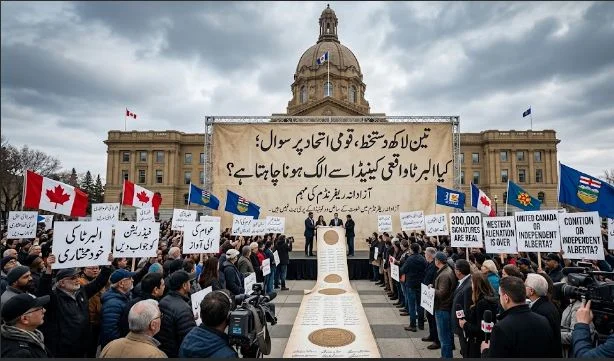
According to The Associated Press, a group campaigning for Alberta’s separation said it submitted approximately 302,000 signatures in May, exceeding the reported requirement of 178,000. The development moved the separation debate beyond political discussion and towards a formal provincial process.
However, collecting signatures and securing majority public support for independence are two different things. A petition can help bring an issue to a vote, but it does not prove that most Albertans want to leave Canada.
Mark Carney’s Warning
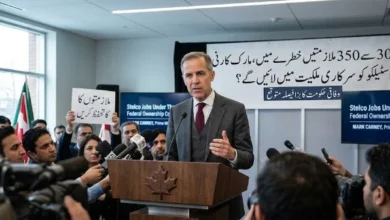
Canadian Prime Minister Mark Carney has urged Albertans to vote against advancing the separation process.
In an Associated Press report published ahead of the referendum, Carney warned that pursuing separation could draw the province into a long and uncertain process. He has also argued that national unity is important at a time when Canada faces significant domestic and international challenges.
For Carney, national unity is more than a symbolic issue. It also affects major infrastructure and economic projects, including energy pipelines, high-speed rail and other initiatives that require cooperation between Ottawa and the provinces. Deepening divisions, he has suggested, could make it more difficult to reach agreement on such projects.
The political disagreement has a clear economic dimension. Alberta’s economy is closely tied to the energy sector, particularly oil and natural gas. Disputes over federal environmental policies, energy production and regulatory requirements have repeatedly strained relations between the province and Ottawa.
Supporters of separation argue that Alberta should have greater control over its resources and policy decisions. Those who favour Canadian unity, meanwhile, believe disagreements should be addressed within the existing federal system rather than through independence.
The central political challenge is therefore not simply deciding which side wins. It is finding an acceptable way to address provincial grievances. If a significant portion of the population feels that its concerns are being ignored, questions about national unity can return to the political agenda.
What Do Albertans Want?
Public opinion is one of the most important factors in the debate over Alberta’s future.
An Ipsos survey released in June 2026 found that 18 per cent of respondents said they would vote for Alberta to separate from Canada if a future binding referendum were held. By comparison, 72 per cent said they would vote for the province to remain in Canada.
These figures reflect public opinion at the time of the survey and should not be treated as a definitive measure of what voters think on October 14. Nevertheless, they offer an indication of the political climate earlier in the year.
The Ipsos findings also showed that support for separation had declined compared with January 2026, when 28 per cent supported the idea. The June survey found that support for initiating a future binding referendum was also limited, with 19 per cent favouring that step and 72 per cent preferring that Alberta remain in Canada.
The distinction matters because political activism and majority public support do not always move together. A movement may collect signatures, organise rallies and place an issue at the centre of national debate without persuading most voters to support its ultimate objective.
Albertans themselves do not share a single view. Some residents have concerns about provincial powers, energy policy and the federal government’s approach to Alberta. But opposition to Ottawa does not necessarily mean support for independence. Some voters may strongly disagree with federal policies while still preferring Alberta to remain within Canada.
For this reason, the October 19 results should not be interpreted solely as a simple yes-or-no verdict on separatism. The ballot contains 10 questions, including proposals concerning immigration and social programmes. The results could provide separate indications of where voters want policy changes and where they prefer the current arrangements to continue.
What Does Quebec’s Experience Tell Us?
Provincial separation is not a new issue in Canadian history. Quebec held two referendums on sovereignty, in 1980 and 1995. The second vote was exceptionally close, with approximately 49.42 per cent voting in favour of sovereignty.
Quebec’s experience demonstrates how a debate over independence can influence a country’s political system for decades. Language, culture, identity and provincial autonomy have all played significant roles in Quebec’s sovereignty movement.
Alberta’s separatist movement has a somewhat different focus. Its grievances are more prominently connected to federal energy policy, economic interests and the distribution of powers between provincial and federal governments. It would therefore be misleading to treat the movements in Quebec and Alberta as identical.
Nevertheless, the two cases share an important feature. When provincial identity and the structure of the federal system become sources of serious disagreement, constitutional questions can become part of everyday political debate.
The outcome of such movements ultimately depends on public support, legal requirements and political negotiations—not simply on the strength of campaign slogans or demonstrations.
National Consequences of a Provincial Vote
Alberta’s referendum could have implications well beyond the province. Its outcome may influence relations between the federal government and other provinces, as well as the future of discussions about provincial autonomy.
If voters show substantial support for advancing the separation process, Ottawa could face increased political pressure to address Alberta’s concerns. That pressure might extend to energy policy, economic priorities and the division of responsibilities between governments.
If voters reject the proposal, the result could be interpreted as support for keeping Alberta within Canada. However, it would not mean that disagreements over energy, immigration or provincial powers had disappeared.
A mixed result could be more difficult to interpret. Different outcomes across the 10 questions may reveal that Albertans want changes in some policy areas while preferring to preserve existing arrangements in others.
Global News reported on October 12 that advance voting was about to begin and that election officials expected a high level of voter participation. Elections Alberta subsequently confirmed that advance voting opened on October 13 and will continue through October 17, ahead of referendum day on October 19.
The level of public interest indicates that the vote has become a significant political event. However, actual turnout and the final results will only become clear once voting and counting are completed.
Is the Decision About More Than One Province?
The debate surrounding Alberta’s referendum raises a fundamental question about Canada’s federal system: how much authority should provinces exercise over their own affairs, and what role should the federal government play when national interests are involved?
For supporters of separation, the vote represents an effort to secure greater control over Alberta’s future. For supporters of Canadian unity, it is a question of national solidarity, economic cooperation and a shared future.
Resolving the disagreement will require more than political rhetoric. It will require governments to consider the concerns behind the movement and determine whether those concerns can be addressed within the existing constitutional framework.
The legal implications are also significant. Under constitutional principles established by the Supreme Court of Canada, a clear expression of public support for separation would not automatically make a province independent. It could create an obligation to negotiate, but the process would involve constitutional requirements and negotiations among relevant parties.
A single referendum cannot, by itself, remove Alberta from Canada.
Ultimately, the October 19 vote will help determine whether Albertans want the provincial government to pursue a more formal process that could lead to a future separation referendum. It will also offer a broader indication of how voters view the federal system and the relationship between Alberta and Ottawa.
The significance of the referendum lies not only in the possibility of separation but also in the wider question of how Canada manages disagreements between its provinces and the federal government. The next stage will depend on the voting results, the applicable legal requirements and the response of political leaders.
For now, the petition signatures have ensured that the debate receives serious attention. Whether that momentum translates into broad public support for separation remains a separate and much more consequential question.