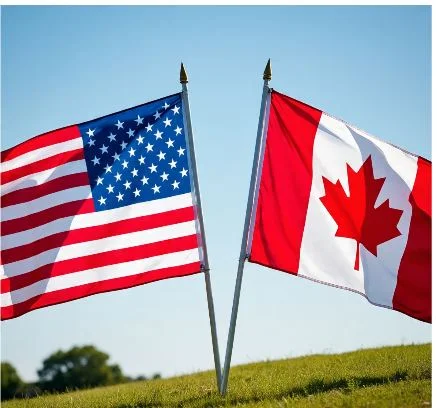
THE TRUE POST (Web News) — Growing trade tensions between the United States and Canada are creating uncertainty among businesses and consumers in Ohio, as tariffs imposed by U.S. President Donald Trump on Canadian products and expected Canadian retaliatory measures raise concerns about their potential economic impact.
Ohio has long played an important role in the U.S. industrial economy, while Canada remains one of the state’s largest export markets. Available trade data shows that Ohio exported approximately $17.5 billion worth of goods to Canada last year, accounting for roughly one-third of the state’s total exports.
At the same time, Ohio imports billions of dollars worth of Canadian products. The close integration of the two economies means that a prolonged trade dispute could affect manufacturers, suppliers, workers and consumers on both sides of the border.
Construction Industry Also Feels the Pressure
Businesses in Ohio are already facing uncertainty as tariffs and changing trade policies make long-term planning more difficult.
Joe Koch, who is associated with a family-owned construction business in Youngstown, said the trade dispute has made it harder for customers to make decisions about building new homes.
According to Koch, some potential customers are delaying construction projects while waiting for better interest rates or hoping that tariffs will eventually be reduced.
His company previously purchased roofing materials from Canada but has now shifted toward a domestic supplier.
Koch said the changing trade environment has affected both supply planning and financial decisions. While greater domestic self-sufficiency may sound attractive, he argued that modern economies still depend heavily on reliable international trading partners and established supply chains.
Youngstown’s Manufacturing Sector Faces Another Challenge
Youngstown was once one of the major centers of the American steel industry.
The city suffered a major economic shock in 1977 when Youngstown Sheet & Tube closed its Campbell Works, resulting in approximately 5,000 workers losing their jobs.
Although the city has since attempted to diversify its economy, manufacturing remains an important part of the local economic base.
According to Bureau of Labor Statistics data, more than 20,000 jobs in the area are connected to manufacturing.
The sector includes steel tubes and pipes, plastics, advanced industrial materials and other manufacturing activities.
Local businesses are concerned that a prolonged trade dispute with Canada could create additional pressure on these industries.
Ohio’s Trade With Canada Is Worth Billions
Canada is an important trading partner for Ohio.
Major Ohio exports to Canada include engines and turbines, motor vehicle parts, plastics, iron and steel products and other industrial goods.
Ohio also imports crude oil, automotive components, plastics, steel and aluminum from Canada.
Because the two economies are closely connected, higher tariffs can affect companies at several stages of the supply chain rather than simply affecting the original importer.
Youngstown is located within Ohio’s 6th Congressional District, which has a population of more than 775,000 people.
The district exports more than $820 million worth of goods to Canada annually, including coal and petroleum products, iron, steel and various industrial goods.
American Consumers Are Also Worried About Higher Prices
The effects of the trade dispute are not limited to businesses.
Some residents in the Youngstown area are also concerned that tariffs could increase the prices of everyday goods.
During conversations with local residents, some said they viewed Canada as a longtime U.S. ally and found the current level of economic tension between the two countries difficult to understand.
Pam Hall, a local resident, expressed concern that tariffs could make everyday products more expensive and put additional pressure on household budgets.
Patricia Vandrover also expressed concern that ordinary Americans should not be viewed as responsible for trade disagreements between the two governments.
Could Canada Turn Permanently to Other Markets?
Some Americans are also worried that prolonged trade tensions could encourage Canada to expand its commercial relationships with countries other than the United States.
Cindy Burns said that if Canada begins developing alternative trading relationships on a larger scale, it could eventually become more difficult for American businesses to regain market share.
Such a shift could potentially affect U.S. factories, exporters and jobs if demand for American-made products declines.
Businesses that depend heavily on cross-border trade are therefore closely watching how the dispute develops.
Trade War Could Have Political Consequences
The economic dispute is also generating political discussion in Ohio.
Some residents believe economic concerns could influence voter behaviour during the November midterm elections.
Larry Kelly said the trade dispute could become an important issue during the midterms. Recent political discussions in Ohio have focused on economic conditions, prices, jobs and the potential consequences of trade policy.
However, not everyone views tariffs negatively.
Mike Glantsis said he had not personally experienced a major impact from the tariffs and believed the United States was responding to tariffs previously imposed by Canada.
The different opinions demonstrate how the trade dispute is producing a mixed reaction among consumers and businesses.
Businesses Divided Over Tariffs
Guy Coviello, president and chief executive of the Youngstown-Warren Regional Chamber, said the impact of tariffs varies significantly from one business to another.
Some companies are facing higher costs and weaker demand, while others may benefit from reduced foreign competition.
According to Coviello, discussions among local business leaders can involve sharply different views, with some companies opposing tariffs while others believe the measures could benefit their operations.
However, data from the Youngstown State University Export Assistance Network indicates that the overall impact of the trade dispute appears negative for the region.
Aluminum Companies Face Supply Challenges
Companies producing aluminum-related products in the Youngstown area are also dealing with the changing trade environment.
Shapes Unlimited, a company that manufactures aluminum doors, fencing and other products, employs around 40 people in the region.
Company president Doug Rande said the business had been interested in expanding its market into Ontario and Quebec because of their proximity to northeastern Ohio.
However, higher transportation costs, rising fuel expenses and tariffs have made that expansion more difficult to justify economically.
Rande also said aluminum supply has become a challenge during the trade dispute.
Tariffs on imported aluminum, combined with stronger demand for domestic and scrap aluminum, have made access to raw materials more difficult for some businesses.
Prolonged Dispute Could Increase Uncertainty
Ohio businesses are now watching closely to see how negotiations between the United States and Canada develop.
Potential Canadian retaliatory tariffs are also creating concern among American companies and agricultural producers that depend on access to the Canadian market.
The situation in Ohio demonstrates that the U.S.-Canada trade dispute is no longer simply a disagreement between governments.
Its effects are reaching manufacturers, construction companies, exporters, workers and consumers.
For businesses, one of the biggest problems is uncertainty. Companies need to make decisions about raw materials, production costs, investments and export markets without knowing how tariff rates or trade policies may change.
If the dispute continues for an extended period, industrial regions such as Ohio could face additional economic pressure.
The outcome will depend heavily on whether Washington and Ottawa can reach a stable trade arrangement that protects businesses while maintaining the deeply integrated supply chains that have connected the two economies for decades.