Muhammad Amanullah
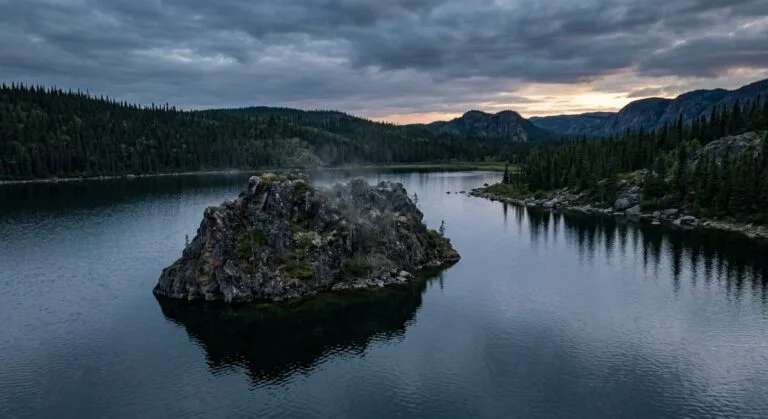
The True Post (Web News) — A mysterious floating island suddenly appeared in a large reservoir in British Columbia, attracting the attention of local residents and experts. The unusual landmass, covered with trees and vegetation, was seen floating in the water before disappearing from satellite images just days later.
The strange phenomenon was observed in the Williston Reservoir in northern British Columbia, where local residents were surprised to see what appeared to be a large tree-covered island floating across the water.
Local Resident Shares Photos and Video
Local resident Rocky Avery received photographs and video of the floating island from a person travelling by boat. Avery shared the material on social media in early August, and the images quickly attracted widespread attention.
Avery said that despite spending around 40 years in the area, he had never witnessed anything similar.
A major fishing activity was also expected to take place in the area, prompting Avery to inform people about the unusual floating island. He also wanted BC Hydro to be aware of the situation in case the island moved toward areas where it could create problems.
BC Hydro Initially Questioned the Footage
BC Hydro spokesperson Bob Gammer said the organization initially had some doubts after seeing the video.
According to Gammer, the growing use of artificial intelligence to create fake images and videos means that material shared online cannot always be immediately considered authentic.
However, satellite imagery later confirmed that the floating island was real and was actually moving through the open waters of the Williston Reservoir.
Island Was About 140 Metres Long
Satellite images showed the floating island west of Finlay Bay and approximately 100 kilometres west of the W.A.C. Bennett Dam.
BC Hydro estimated that the unusual landmass was approximately 140 metres long and 70 metres wide.
Its total area was estimated at around 9,800 square metres, roughly equivalent to two American football fields.
Floating Island Disappeared From Satellite Images
Satellite imagery from July 21 clearly showed the island in the reservoir. However, by August 5, the latest satellite images no longer showed any sign of it.
BC Hydro said this does not necessarily mean the island sank.
One possibility is that wind or water currents pushed the floating landmass back toward a relatively sheltered shoreline where it could no longer be easily detected from satellite imagery.
The utility said the floating island was not expected to have any significant impact on electricity generation or dam operations. However, officials continue to monitor the area for any possible reappearance.
Unusually High Water Levels May Have Played a Role
Experts believe unusually high water levels in the Williston Reservoir this year may have contributed to the formation and movement of the floating island.
The Williston Reservoir was created following the construction of the W.A.C. Bennett Dam and was first filled in the late 1960s. It is one of the world’s largest reservoirs and is large enough to be visible from space.
This year, heavy winter snowfall followed by persistent summer rainfall contributed to unusually high water levels.
During June and July, additional outlets at the dam had to be opened to help manage the water level and pressure.
Trees and Natural Debris May Have Formed the Island
BC Hydro believes the floating island may have developed over several years along one of the reservoir’s shorelines.
One possible explanation is that large amounts of wood and natural debris accumulated along the shoreline. Plants and trees may then have taken root within the accumulated material.
Over time, the vegetation and debris could have formed a relatively strong floating mass.
When the water level rose significantly, the landmass may have separated from the shoreline and been pushed into open water by strong winds.
Gammer said the reservoir had not reached its full level for approximately 14 years, meaning the unusually high water level this year may have helped create the conditions that allowed the floating landmass to break away.
Rocky Avery also noted that higher water levels had affected sandy areas along the shoreline and carried more trees and natural debris into the reservoir than usual.
Similar Floating Islands Exist Around the World
Although the appearance of such a large floating island in the Williston Reservoir is unusual, similar natural phenomena have been observed in other parts of the world.
In Wisconsin, large sections of wetland separated and began floating on an artificial lake after the reservoir was created. One large floating section has reportedly needed to be moved by boat to prevent it from drifting toward a bridge.
Researchers have also studied floating islands in Lake Victoria in Africa, examining how these formations can affect transportation, fishing and water quality.
The Mystery May Not Be Over
The floating island that appeared in British Columbia’s Williston Reservoir has disappeared from recent satellite images, but BC Hydro continues to monitor the area.
Its sudden appearance and disappearance demonstrates how changing water levels, wind, natural debris and vegetation can combine to create unusual floating land formations.
Although the island did not appear to pose a major threat to the reservoir’s operations, its brief appearance has provided a fascinating example of how natural landscapes can temporarily change when water levels rise dramatically.
For now, officials will continue monitoring the reservoir to determine whether the mysterious floating island eventually reappears somewhere along its vast shoreline.