Muhammad Amanullah
Date: October 14, 2026
The True Post (Web News) —
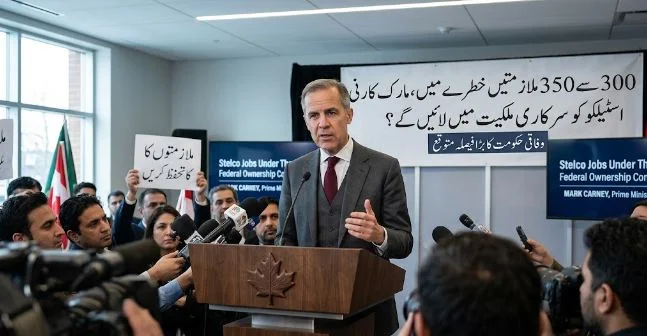
The future of Canada’s steel industry and industrial jobs has become the focus of an escalating political dispute, with federal and Ontario New Democratic Party leaders urging Prime Minister Mark Carney’s government to consider bringing Stelco under public ownership.
The demand comes after US-based Cleveland-Cliffs announced plans to lay off between 300 and 350 employees at Stelco’s steelmaking facility in Hamilton, Ontario. The company has refused to reverse the planned job cuts despite pressure from the Canadian government.
Federal Industry Minister Mélanie Joly has said the move could violate conditions established when Cleveland-Cliffs acquired Stelco under Canada’s Investment Canada Act.
Federal NDP Leader Avi Lewis said on Tuesday that the government must act quickly to protect workers and Canada’s domestic steel industry. He warned that relying solely on court proceedings could take too long to protect employees whose jobs are at risk.
Canada cannot afford to lose its steel industry, Lewis argued, calling for immediate government intervention to preserve employment and the country’s industrial capacity.
Dispute Over the Acquisition Agreement
Cleveland-Cliffs acquired Stelco in 2024. As part of the acquisition arrangements, the company committed to maintaining the number of unionized employees for five years and keeping non-union employment at approximately the same level.
The Canadian government says the proposed layoffs raise questions about whether those commitments are being honoured. Cleveland-Cliffs chief executive Lourenco Goncalves, however, maintains that the company is acting within the law.
Goncalves has described the layoffs as temporary, saying they could continue until a trade agreement is reached between Canada and the United States.
He has argued that the acquisition agreement did not require the company to maintain a fixed number of employees every single day throughout the five-year period. Had such a daily staffing requirement been imposed, he said, he would not have accepted the agreement.
Joly has indicated that legal action against the company remains an option. In a social media statement on Saturday, she said the government was keeping all possible avenues open.
According to the minister, government lawyers are reviewing the next steps. The dispute has intensified since the company declined to reverse its planned layoffs.
NDP Calls for Public Ownership
Ontario NDP Leader Marit Stiles called on Carney and Ontario Premier Doug Ford to intervene, raising the issue in the provincial legislature.
Stiles said Ford should work with the federal government to persuade Cleveland-Cliffs to relinquish ownership of Stelco. She called for the steelmaker to be brought into public ownership and managed under Canadian leadership.
She warned that failure to act could ultimately cost thousands of jobs, with consequences extending beyond Stelco to related businesses and the wider Hamilton economy.
Ontario NDP legislators Sandy Shaw and Robin Lennox, both associated with Hamilton, have also called for immediate action from the federal and provincial governments.
They have advocated a relief package involving tariff-related measures for the steel industry and policies that prioritise domestic procurement. Their proposal includes giving Ontario-made products preference in government purchasing.
The demands have emerged while the Ontario legislature is on an extended break. The legislature is scheduled to resume sitting on October 27.
CBC Hamilton sought a response from Ford’s office regarding the call for public ownership. At the time of the report, no response had been received.
British Steel Cited as an Example
Lewis has pointed to the United Kingdom as an example of government intervention in the steel sector.
He said the British government brought British Steel into public ownership in July, with the aim of protecting thousands of jobs. He also referred to plans announced in September to bring another steelmaker, Speciality Steels, into public ownership.
Lewis argues that Canada should consider similar measures to protect its industrial capacity and employment. He has also criticised Cleveland-Cliffs’ leadership for supporting tariffs on US steel, arguing that US trade measures are weakening Canadian industry and damaging its manufacturing base.
Not all experts, however, have endorsed nationalisation as the necessary solution.
Nicholas Lamp, an associate professor of law and policy studies at Queen’s University, said the government should take Stelco’s situation seriously. He noted that Canada is focused on building infrastructure, major industrial facilities and other large projects, making the preservation of steelmaking expertise and experience an important consideration.
Lamp cited the federal government’s 2018 purchase of the Trans Mountain pipeline from Kinder Morgan as an example of critical infrastructure being transferred from private ownership to the public sector.
However, he did not specifically recommend bringing Stelco under public ownership. Instead, he said the government should carefully examine the reasons for the layoffs and the company’s decisions.
He also suggested considering whether a company that placed Canadian workers and national interests first might have made a different decision under similar circumstances.
Pressure Mounts on Mark Carney
Last week, Carney said he would wait for Cleveland-Cliffs to respond to a letter from Joly calling for the jobs to be restored. He said the government would determine an appropriate course of action after receiving the company’s response.
Cleveland-Cliffs’ refusal to reverse the layoffs has increased pressure on the federal government to explain what it intends to do to protect workers and enforce any commitments made during the acquisition.
Federal Conservative Leader Pierre Poilievre has supported legal action against Stelco’s owner but has also called for a trade agreement with the United States that would eliminate tariffs.
Speaking in Windsor on Tuesday, Poilievre urged the prime minister to return to the negotiating table and secure a tariff-free agreement. He said workers at Stelco, Stellantis, Ford and other businesses dependent on cross-border trade expected the prime minister to fulfil his commitments.
A Wider Debate Over Canada’s Industrial Future
The Stelco dispute has grown beyond the immediate question of layoffs. It has become part of a broader debate over Canada’s industrial policy, US trade tariffs and the ownership of strategically important industries.
The federal government faces several challenges: determining whether the acquisition commitments have been breached, deciding whether legal proceedings are warranted, and assessing the potential effects on workers, industrial expertise and Hamilton’s economy.
Public ownership remains a proposal advanced by political leaders, not a confirmed government decision. With Cleveland-Cliffs refusing to reverse its planned cuts, pressure is mounting on Ottawa to clarify how it will protect Canadian steelmaking capacity and the workers whose livelihoods depend on it.
The government’s next steps could have implications beyond Stelco, shaping the debate over how Canada should respond when trade tensions threaten jobs in strategically important industries.