Muhammad Amanullah | August 10, 2026
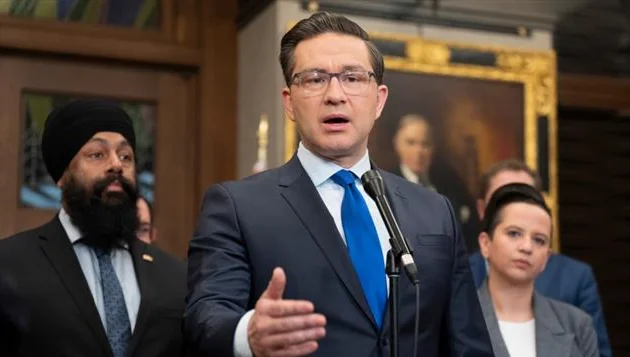
Canada’s Conservative Party leader Pierre Poilievre is calling on Prime Minister Mark Carney to take a tougher position in ongoing trade negotiations with the United States and avoid repeatedly giving in to demands from U.S. President Donald Trump.
In a letter to Prime Minister Carney, Poilievre argued that Canada must protect its national interests during negotiations with Washington and should not accept a deal that requires Canada to make continuous concessions without receiving meaningful commitments in return from the United States.
Poilievre Criticizes Canadian Concessions
Poilievre and Conservative critic for Canada-U.S. relations Shuvaloy Majumdar argued in the letter that Ottawa has changed its position on several issues in response to American demands over the past year.
They pointed to Canada’s decision to eliminate the digital services tax, withdraw retaliatory tariffs against the United States and agree to give the U.S. a share of net toll revenue from the new Gordie Howe International Bridge connecting Windsor, Ontario, with Detroit, Michigan.
Poilievre said that despite these concessions, Canada continues to face additional pressure on the trade front.
Concerns Over Higher Tariffs
The Conservative leader claimed that the United States has increased and expanded tariffs on Canadian steel and aluminum, while tariffs on Canadian softwood lumber have also increased significantly.
Poilievre said Canada needs a trade strategy that does not involve continuously backing down but instead establishes clear conditions designed to protect Canadian economic interests.
He told the prime minister that Canadians want a “good deal” that includes zero tariffs on softwood lumber, the removal of sector-specific tariffs on steel and aluminum, and a tariff-free agreement for the automotive sector.
New U.S. Tariffs Expected August 19
The United States is expected to impose new 50% tariffs on a range of Canadian goods beginning August 19.
With the deadline approaching, trade negotiations between Canada and the United States have accelerated as both sides attempt to reach an agreement.
The Canadian government is considering several proposals aimed at securing tariff relief for Canadian industries and reducing the impact of U.S. trade measures.
American Alcohol Sales Become a Key Issue
Restrictions on the sale of American alcohol in Canada have also emerged as an important issue in the trade negotiations.
According to the information provided in the report, the Canadian government is considering whether some provincial restrictions on the sale of American alcohol could be removed as part of efforts to secure tariff relief from Washington.
However, provinces have shown resistance to the idea because provincial governments play an important role in regulating alcohol sales.
Dairy Sector Under Pressure
The United States has also repeatedly criticized Canada’s supply management system, particularly its policies protecting the domestic dairy sector.
U.S. President Donald Trump has complained on several occasions that American dairy products do not have sufficient access to the Canadian market.
Prime Minister Mark Carney has made clear that his government continues to support Canada’s supply management system.
Dairy Farmers of Canada has also urged the federal government to protect the interests of the dairy industry during negotiations and avoid making further concessions.
The dairy sector argues that Canada has already made several concessions, while new demands continue to emerge from Washington.
Pressure on Carney Government Grows
The Conservative Party argues that repeated concessions could hurt employment in Canadian industrial communities, particularly areas whose economies depend heavily on cross-border supply chains with the United States.
Poilievre has also challenged Carney’s position that “a bad deal is worse than no deal.”
According to the Conservative leader, Canada should seek an agreement that protects Canadian industries, workers and the country’s broader economic interests.
Strategic Critical Minerals Stockpile Proposed
The Conservative Party has also repeated its proposal for Canada to establish a strategic stockpile of critical minerals as a way to strengthen the country’s negotiating position.
The party has suggested that access to the stockpile could be offered to countries willing to keep their markets tariff-free for Canadian products.
The proposal is intended to use Canada’s critical natural resources as leverage in international trade negotiations.
Uncertainty Over CUSMA
Canada and Mexico indicated last month that they wanted to extend the Canada-U.S.-Mexico trade agreement, CUSMA, for another 16 years.
However, the United States has instead pursued the possibility of reviewing the agreement on an annual basis, creating additional uncertainty over the future of North American trade relations.
Trade Talks Intensify
With the August 19 deadline for new U.S. tariffs approaching, Canada and the United States have intensified their negotiations.
The Canadian government is considering concessions in certain sectors in exchange for tariff relief, while dairy farmers, provincial governments and other groups are urging Ottawa to proceed cautiously.
At the same time, pressure from the Conservative Party is increasing for the government to adopt a stronger and clearer position in negotiations with Washington.
The central challenge for Prime Minister Mark Carney will be balancing the need to secure tariff relief with the protection of Canadian industries, jobs and long-term economic interests.